

THE RULES EVERY WOODWORKER SHOULD KNOW BEFORE MAKING THE FIRST CUT
There is a deep satisfaction in stepping into a wood workshop.
The smell of new timber. The sound of a saw cutting thru a plank. That feeling of taking a rough piece of wood and making it useful and beautiful and all your own.
But like all things, there is another side to woodworking that all beginners, and all seasoned woodworkers, need to respect.
The safety of a workshop depends on the habits practiced inside it.
A pleasant afternoon can turn to tragedy in seconds when sharp blades, spinning machinery, flying debris, wood dust, electrical equipment, heavy materials, or an unexpected kickback cause a serious accident.
The good news is?
Most workshop accidents can be avoided by developing the right habits before the tools are switched on.
These practical safety principles will help you work with more confidence, control, and peace of mind whether you’re building your first little project or running a fully equipped woodworking shop.
The Significance of Woodworking Safety
Woodworking is a relaxing hobby, and it can be.
But power tools are machines that cut, drill, shape and remove material at incredibly high speeds.
This means that they deserve respect.
A table saw doesn’t care if you are a seasoned craftsman or if you are using a tool for the first time. The router does not know that you are tired. A drill doesn’t know your hand is too close to the bit.
A machine or a tool will just do what it is designed to do.
Your job is to understand the tool, control the workpiece, and take care of the equipment and make a place for work where mistakes are less likely to be made.
Safety means not being afraid of woodworking. It’s about preparedness.
1. ACQUIRE THE APPROPRIATE SAFETY GEAR
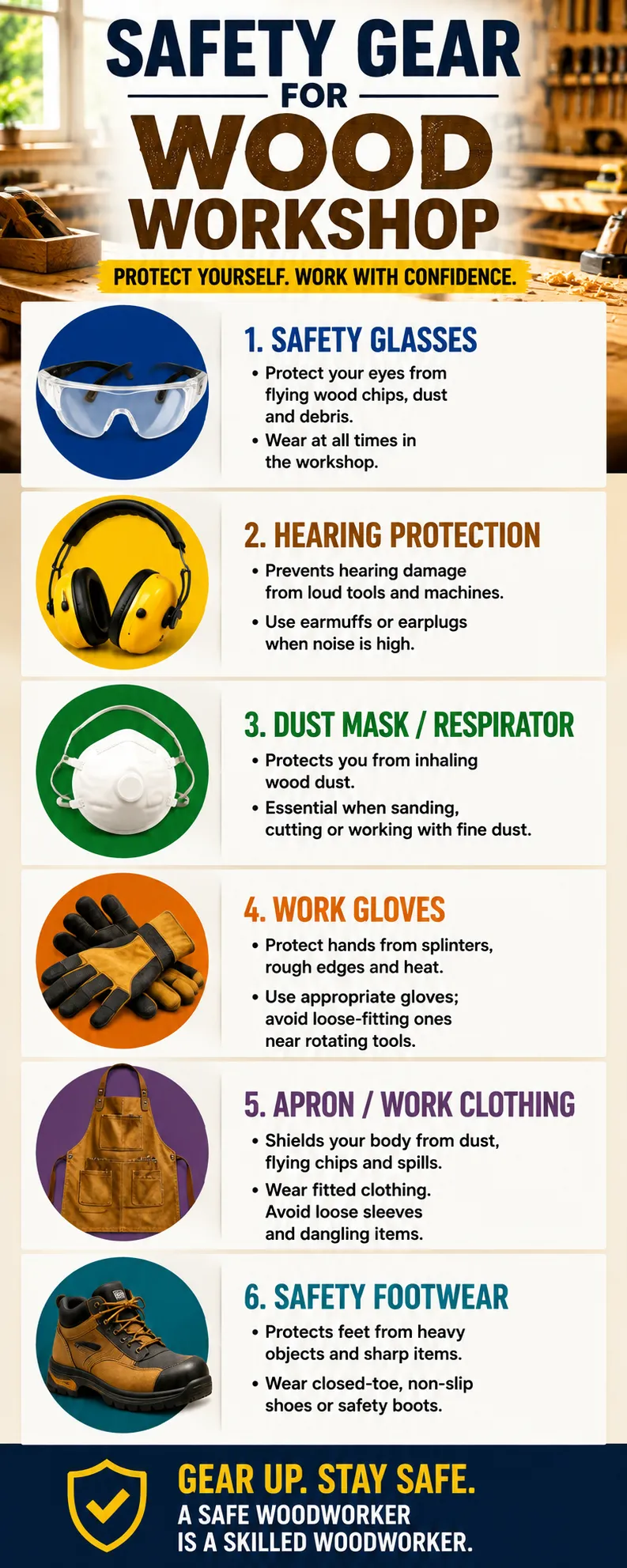 Before you pick up a piece of timber, consider protecting the most vulnerable parts of your body.
Protecting Your eyes
Top of that list should be your eyes.
Cutting, drilling, routing or sanding can cause wood chips, sawdust, broken blades and small fragments to fly into the air. And a good pair of safety glasses or goggles can give you an important layer of protection.
Protecting Your Ears
Hearing protection is just as important when you’re working around loud machinery. Saws, routers, planers, sanders and other power tools can be very noisy.
Protecting Your Nose
You will also need adequate respiratory protection when undertaking dusty operations. Dust control is a big part of workshop safety. Fine wood dust can become airborne when you sand and cut.
Protecting Your Clothes
Your clothing counts too.
Do not wear loose sleeves or dangling accessories, scarves, necklaces or other items that could get caught in rotating machinery.
Wear footwear with good grip, especially in workshops where sawdust and offcuts may collect on the floor.
Consider safety gear as an integral part of your woodworking toolbox, not something extra.
2. KEEP YOUR WORKSHOP CLEAN AND TIDY
A messy workshop is more than a mess. It can be dangerous
Imagine trying to manoeuvre a large board through the shop, dodging extension cords, scrap pieces, and tools that have fallen out of their place. Things that are misplaced could cause you to trip. If you trip, you or the material you are carrying could be sent into a machine.
Good housekeeping eliminates a lot of needless hazards.
Keep walkways clear.” Take off the offcuts regularly. Store tools when not in use. Clear sawdust and other debris.
Your workbench should be big enough for the work you are doing. Crowded benches make it harder to control materials and easier to knock tools to the floor.
There is also the advantage in increased productivity.
A structured workshop may help you to think more clearly.
When every tool is stored in its place, you spend less time searching and more time working.
3. GET TO KNOW YOUR TOOLS BEFORE YOU USE THEM
One of the biggest mistakes a beginner can make is assuming that the power tool is self-easy to follow.
It isn’t.
Before using a new machine, take time to understand how it works. Read the manufacturer’s instructions and become familiar with its controls, guards, adjustments, and limitations.
Learn how the tool should be started and stopped.
Understand the positioning of your body and hands when using the machine.
Get to know how the workpiece should be supported when operating the machine.
And most importantly, understand what can go wrong.
Never remove a safety guard simply because it appears annoying or inconvenient. The manufacturer put guards and other safety mechanisms to protect the user. They are there because the machine can become a hazard without them.
Safety should be a priority before you use an equipment.
Convenience should never replace safety.
4. RESPECT EVERY BLADE
It is important to note that every blade deserves to be handled with care whether it is new or used. A sharp blade deserves even more respect when handling.
It is worthy to note that a sharp blade can provide better control than a damaged or poorly maintained one. Dull or damaged cutting tools may require excessive use of force, hence increasing the likelihood of losing control.
Before cutting, inspect the blade and make sure it is appropriate for the material and task.
Never attempt to grab a falling or moving piece of wood near a blade.
If a workpiece becomes stuck, don’t immediately reach toward the cutting area.
Turn the machine off and wait for it to stop completely. Then investigate or remove the piece.
This simple habit can prevent a serious injury.
5. UNDERSTAND KICKBACK
Kickback is one of the hazards that every woodworker should understand.
It occurs when a workpiece is suddenly thrown back toward the operator by a machine, particularly in certain cutting operations.
The force can be surprisingly powerful.
To reduce the risk, you need to first understand the correct technique for the specific machine before you being using it.
Keep the workpiece properly supported and follow the manufacturer’s operating instructions. Use appropriate fences, guides, guards, push sticks, and other safety accessories.
Never stand directly in a position where a potential kickback could send material straight toward you.
Most importantly, don’t force the wood through the machine.
If the material starts behaving unexpectedly, stop and reassess.
6. KEEP YOUR HANDS OUT OF THE DANGER ZONE
Your hands are your most valuable woodworking tools. They should never become part of the cutting process.
Always, use the appropriate accessories to keep your hands away from blades and cutters.
Push sticks, push blocks, clamps, feather boards, jigs, and other devices can help provide greater control while maintaining a safer distance.
When a workpiece becomes too small to handle safely using the normal technique, stop and reconsider how the cut should be made.
A few extra minutes spent setting up a jig or guide are insignificant compared with the consequences of an injury.
Good woodworking is controlled woodworking.
7. SECURE YOUR WORKPIECE
Trying to hold a piece of wood in one hand while operating a power tool with the other hand renders poor control and is a recipe for hazard.
Where appropriate, secure your workpiece using clamps, Vises, Jigs, or other suitable methods.
A stable workpiece is easier to cut accurately and reduces unexpected movement.
This is particularly important when drilling, routing, sanding, chiselling, or performing operations where the material could shift.
If the piece of wood moves unexpectedly, the tool can also move with it.
Secure the work before you start the tool.
8. DON’T IGNORE WOOD DUST
Wood dust is one of the most overlooked workshop hazards. It may seem harmless. But it can spread quickly throughout a workspace, particularly during sanding, routing, or cutting.
Good dust management begins with source control.
Where possible, use appropriate dust extraction equipment connected to the machinery producing the dust. Maintain good ventilation and clean surfaces regularly.
A suitable respirator or other respiratory protection may also be appropriate depending on the operation and the level of exposure.
Dust can also accumulate in hidden areas, including around machinery and electrical equipment.
Don’t wait until the workshop looks completely covered in sawdust before cleaning it.
Dust control should be part of the workflow—not an afterthought.
Clean up and vacuum the workshop as frequently as possible.
9. HANDLE ELECTRICAL EQUIPMENT CAREFULLY
Woodworking shops often contain multiple electrical tools operating in the same environment.
You need to inspect cords and plugs regularly for any damage. Avoid using equipment with damaged electrical components or cords.
Keep electrical connections away from water and other sources of moisture. Always ensure that extension cables are suitable for the equipment being used. They should be appropriately positioned so they do not create trip hazards.
Do NOT overload electrical outlets.
Before performing maintenance, adjustments, or cleaning on any powered equipment, make sure the machine is switched off and appropriately disconnected according to the manufacturer’s instructions.
Electricity is invisible, and that doesn’t make it harmless.
10. INSPECT YOUR TIMBER BEFORE CUTTING
Reclaimed wood can produce beautiful projects, but it can also contain surprises.
Old timber may contain nails, screws, staples, stones, or other objects embedded in it.
Before cutting reclaimed materials, inspect them carefully and remove hazards where possible.
A hidden nail can damage a blade, cause unexpected movement, or send fragments flying.
Also inspect the condition of the piece of wood for cracks, excessive warping, splits, or unstable sections. These may make certain operations unsafe.
Don’t assume that because a piece of wood looks good, it is automatically safe to put through a machine.
Inspect first before you cut it.
11. AVOID DISTRACTIONS
Woodworking, like any other occupation requiring coordinated use of our body parts (hands, eyes, legs etc) requires absolute concentration.
That means phones, conversations, loud distractions, and unnecessary interruptions should be minimized when operating machinery.
Never operate power tools when you are excessively tired or unable to focus.
Fatigue can affect reaction time and decision-making.
Avoid conversations when working with tools and machinery. If you absolutely have to have a conversation, stop what you are doing, finish the conversation, before you proceed.
Rushing is also another major problem.
Perhaps you could be trying to finish one final cut before dinner, and you want to rush it. Don’t! Maybe you have been working on a project for six hours and want to get it finished.
That’s precisely when mistakes happen. If your concentration is fading, take a break.
There is no woodworking deadline worth an injury.
12. DON’T WORK UNDER THE INFLUENCE
This should be obvious, but it deserves emphasis.
Never operate woodworking machinery while under the influence of alcohol, recreational drugs, or medication that impairs alertness, coordination, or judgment.
Power tools require attention and precise control.
If you aren’t fully alert, don’t use them.
13. MAINTAIN YOUR TOOLS
A safe workshop depends on well-maintained equipment and tools.
Inspect blades, cords, guards, switches, bearings, belts, and other components regularly according to the manufacturer’s recommendations.
Replace damaged or worn parts appropriately.
Keep cutting tools maintained as recommended.
A poorly maintained machine can behave unpredictably.
Maintenance isn’t simply about extending tool life.
It is part of your safety system.
14. LEARN THE EMERGENCY PROCEDURES
Even with excellent safety practices, emergencies can happen.
Every workshop should have a suitable first-aid kit that is easy to access.
Know where the main electrical shutoffs are located.
Keep exits and pathways clear.
Make sure everyone who uses the workshop understands basic emergency procedures.
It is also wise to know how to respond to different types of incidents and when professional medical attention is required.
Don’t wait until something goes wrong to discover that you don’t know where the emergency equipment is.
15. FIRE SAFETY MATTERS
Wood dust and timber are combustible materials, making fire prevention particularly important.
Keep dust accumulation under control and avoid allowing combustible materials to build up around heat sources or electrical equipment.
Store finishing products, solvents, and other flammable materials according to their labels and applicable safety requirements.
Have appropriate fire-safety equipment available and make sure you know how to use it and are located in an easy to access location.
Most importantly, never ignore unusual smells, sparks, overheating equipment, or damaged electrical components.
Small warning signs are easier to deal with than major emergencies.
16. DEVELOP A PRE-PROJECT SAFETY ROUTINE
One of the best ways to improve workshop safety is to create a simple routine checlist.
Before starting a project, ask yourself:
Is my workspace clear?
Are my tools in good condition?
Do I have the right protective equipment?
Is the workpiece secure?
Do I understand the cutting operation?
Where are my hands going to be?
What could go wrong?
What will I do if something goes wrong?
These questions take only a few minutes.
But they can dramatically improve your preparation.
17. DON’T LET EXPERIENCE CREATE OVERCONFIDENCE
Experienced woodworkers can sometimes become less cautious because they have performed the same task hundreds of times.
That’s when complacency can creep in.
A familiar machine is still a powerful machine.
A routine cut can still go wrong.
Experience should make you more disciplined, not less careful.
The best craftsmen aren’t necessarily the people who take the biggest risks.
They’re the people who understand how to control them.
18. TEACH SAFETY TO EVERYONE IN THE WORKSHOP
If children, students, employees, friends, or other people use your workshop, safety becomes a shared responsibility.
Make sure everyone understands the rules before using equipment.
Clearly communicate which machines they are permitted to operate and under what conditions.
Children should receive age-appropriate supervision and should not be allowed to operate dangerous equipment simply because they are curious.
A workshop culture where people remind each other about safety is far stronger than one where everyone works independently.
Safety becomes powerful when it becomes shared and part of the culture.
19. USE JIGS AND GUIDES TO IMPROVE CONTROL
One of the secrets of efficient woodworking is using the right setup.
Jigs and guides aren’t only useful for improving accuracy. They can also help keep hands away from dangerous areas and make repetitive operations more predictable.
A well-designed jig can transform an awkward operation into a controlled one.
This is especially valuable when making multiple identical cuts.
Instead of relying on your hands to position every piece, create a setup that does some of the work for you.
Good workshop design reduces unnecessary risk.
20. PLAN BEFORE YOU CUT
The old woodworking saying, “Measure twice, cut once,” contains a lesson that goes far beyond accuracy.
Planning gives you time to think.
Before switching on a machine, consider the sequence of operations.
- Where will the material go?
- Where will the offcut go?
- How will you support the workpiece?
- Where will your hands be?
- What happens after the cut?
- Do you have enough workspace?
- Will the material become unstable?
A few minutes of planning can prevent mistakes that take hours to fix.
And sometimes the safest decision is simply to stop and find a better way.
THE GOLDEN RULE OF WOOD WORKSHOP SAFETY
There are hundreds of individual safety recommendations for woodworking, but they all come down to one fundamental principle:
Never allow speed, convenience, or confidence to replace good judgment.
Your workshop should be a place where creativity and caution work together.
Wear appropriate protection.
Keep your workspace organized.
Understand your machines.
Secure your work.
Keep your hands away from cutting areas.
Control dust.
Maintain your equipment.
Stay focused.
And never be afraid to stop.
The goal isn’t simply to complete a project.
The goal is to enjoy woodworking for years to come.
FINAL THOUGHTS
Woodworking can teach patience, precision, creativity, problem-solving, and craftsmanship. It can transform a simple piece of timber into furniture, decorations, gifts, tools, and objects that become part of everyday life.
But great woodworking starts before the first cut.
It starts with preparation.
It starts with respecting your tools.
It starts with understanding the material.
And most importantly, it starts with creating an environment where you can work confidently without taking unnecessary risks.
The safest woodworker isn’t the one who never makes mistakes. It’s the one who builds habits that make mistakes less likely—and knows when to stop, reassess, and try a safer approach.
So, before you switch on that saw, router, planer, drill, or sander, pause for a moment.
Look around your workshop.
Check your equipment.
Secure your material.
Put on your protective gear.
Think through the cut.
Then get to work.
Because the best project isn’t just one that looks amazing when it’s finished.
It’s one you can build safely, confidently, and proudly from beginning to end.